
Key Guide For Plastic CNC Machining
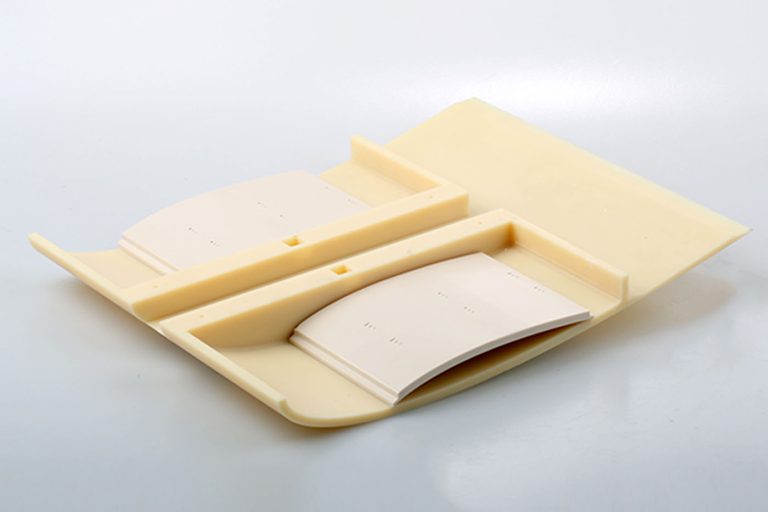
Plastic CNC machining is a subtractive manufacturing process in which a solid block of plastic is placed against a moving cutting tool that carves away material from the block. The cutting tool follows a set tool path, guided by a digital design file, in order to shape the final part. CNC machining is a popular manufacturing method for creating plastic components. With this manufacturing process, you can quickly produce thousands of uniform and precise parts with incredibly tight tolerances.
You can make many different types of plastic parts using CNC machining, including:
Depending on the CNC machining method—CNC drilling, CNC turning, or CNC milling—engineers must adhere to distinct guidelines to manufacture superior plastic CNC machined parts. In this article, we’ll break each of them down.
Medical devices, such as dental implants, surgical guides, and cardiac implants
Food and beverage industry components, such as spray bars and assembly line pieces
Semiconductor components, such as electrical insulators and watertight seals
Automotive and aerospace industry components, such as fire blockers, valve seats, and pump gears
Plastic CNC Turning
CNC turning involves holding a plastic piece in place on a lathe, which is then rotated against the cutting tool in a spinning or turning motion. There are many different forms of CNC turning, each with its own unique purposes and results. For instance, straight or cylindrical CNC turning is best for large cuts, while taper CNC turning creates a distinct cone-like shape.
Specific guidelines for crafting plastic parts with CNC turning machines include:
Minimizing rubbing by making sure cutting edges have a negative back rake
Using generous relief angles for cutting edges
Polishing top surfaces to help reduce material buildup and yield a superior surface finish
Utilizing fine C-2 grade carbide inserts
For rough cuts, we recommend using a feed rate of 0.015 IPR. For more precise final cuts, we recommend a feed rate of 0.005 IPR. Product teams should also know that clearance angles, rake angles, and side angles will vary depending on the material used in CNC turning.
Plastic CNC Milling
CNC milling is a computer-controlled milling process that uses a cylindrical rotating tool, called a milling cutter, to remove material from a solid workpiece and reveal a finished part. CNC milling machines can be broken down into two broad categories — 3-axis mills and multi-axis mills. 3-axis mills move the cutting tool or the workpiece along three linear axes — left to right, back and forth, up and down — and are best for crafting simpler designs. Multi-axis mills, including milling machines with four axes or more, are ideal for manufacturing plastic parts with complicated geometries.
Specific guidelines for fabricating plastic parts via CNC milling include:
Utilizing carbon tooling if you’re machining with a thermoplastic that has been reinforced with glass or carbon fibers
Employing clamps to achieve higher spindle speeds
Generating rounded internal corners and pockets with end mills to mitigate stress concentration.
Plastic CNC Drilling
CNC drilling involves using a drill bit to bore holes into a plastic block. A spindle, which secures the block and CNC drill, lowers onto the block and then drills the appropriately sized holes. There are multiple kinds of drill presses you can utilize with a CNC drilling machine, including upright, bench, and radial CNC drill presses.
When you’re creating plastic components via CNC drilling, you must keep CNC drill bits sharp. Dull or incorrectly shaped drills can put too much stress on the part, causing tooling problems and performance issues. For most thermoplastics, we recommend employing a 90 to 118° drill bit with a 9 to 15° lip angle. If you’re drilling with acrylic, you should use a 0° rake.
The ejection of the CNC drill is also essential, as poor chip ejection can cause friction and build heat. Since CNC drilling generates more heat than any other CNC machining process, heat reduction is critical to minimizing stress and damage. To safely remove a CNC drill without harming the part, try to ensure the drilling depth isn’t more than three or four times the drill diameter and reduce the feed rate when the drill has almost exited the material.
Plastic CNC Machining with Leland
Following the guidelines in this article can help you successfully craft plastic parts with CNC drilling, turning, and milling. But keep in mind that these guidelines are just that — guidelines! Depending on the complexity of your project, you might need to adjust these guidelines to suit your specific manufacturing requirements.
n experienced manufacturing partner like Leland can assist you in making the right decisions when it comes to plastic CNC machining. Our team can provide you with expert advice throughout the entire manufacturing process, taking all necessary guidelines into consideration. At Leland, we’re committed to helping you produce the finest possible CNC-machined plastic part. Ready to elevate your project? Contact us today.